
ChatGPT increasingly resembles a search engine
OpenAI has published two years of data on how people use ChatGPT. It offers a rare glimpse into what users really ask. Impacted: search, marketing, or communications
OpenAI has published two years of data on how people use ChatGPT. It offers a rare glimpse into what users really ask, rather than just what they say they use AI for.
The dataset covers a monthly sample of around one million messages from July 2024 to September 2026. It includes individual Free, Go, Plus, and Pro accounts, but not Enterprise or Codex accounts, so it offers an interesting picture, though not a complete record of every way ChatGPT is used. Even so, the patterns observed should be of interest to people working in search, marketing, or communications.
ChatGPT increasingly resembles a search engine
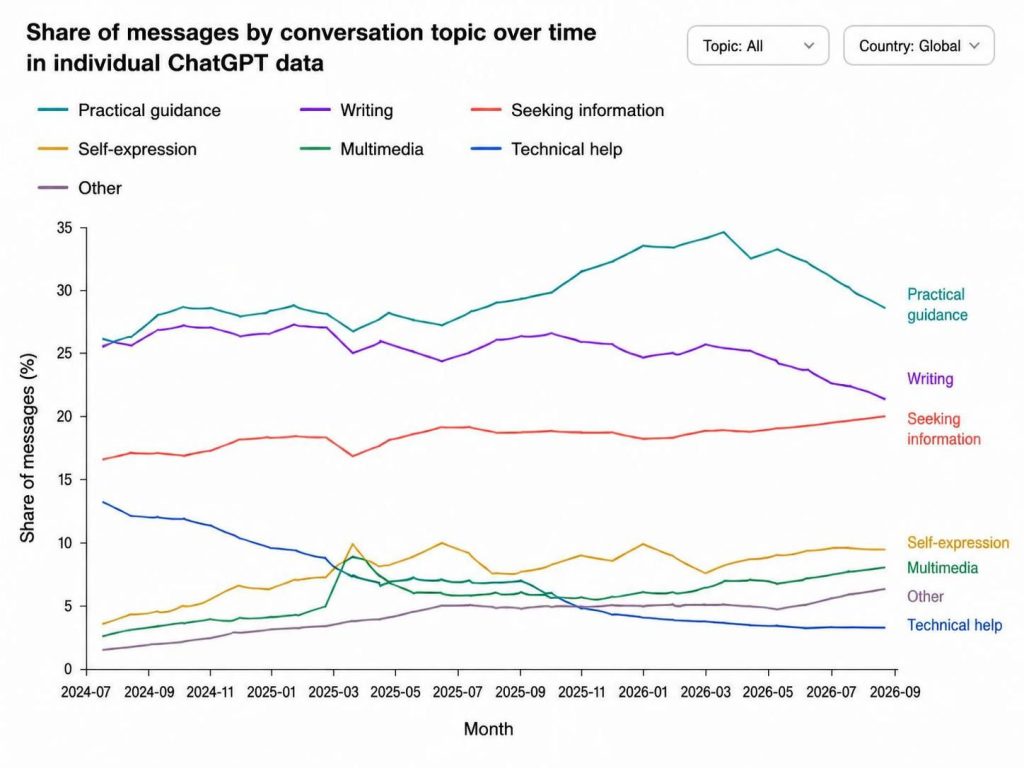
The share of messages classified as “information seeking”–including questions about facts, products, services, and regulations–increased from 16.7% in July 2024 to 20.2% in September 2026. Over the same period, the share of writing-related tasks fell from 34.1% to 21.4%. In August 2026, information seeking briefly overtook writing; in September, writing edged ahead again.
This marks a significant shift in how people use the tool. ChatGPT is still used to create and edit text, but more people are also turning to it for answers and help comparing options.
Most users use ChatGPT outside of work
The data show that ChatGPT is as useful in everyday life as it is as a productivity assistant. According to OpenAI’s data for September 2026, 32.2% of messages were work-related, meaning most were not. The broader category of non-work uses covers a range of personal needs–from everyday questions to planning and learning.
An important distinction is worth keeping in mind: this data covers messages sent from individual accounts. It does not include all ChatGPT use through company-managed accounts, so it should not be treated as a complete picture of AI use in the workplace.
ChatGPT is used differently at work and at home
Outside of work, people are more likely to ask questions and seek information. At work, they are more likely to ask ChatGPT to complete a specific task: write or edit text, analyze something, or produce a particular result. Writing remains an important work-related use, but the broader pattern points to task delegation–using an assistant to help get things done, rather than simply explain a topic.
This distinction matters to marketers. A consumer might ask for advice on choosing a product, while a professional might request a comparison of suppliers, a summary of prices, or a first draft of a recommendation.
Research bridges professional and personal uses
For most of the period studied, information-seeking messages accounted for about 11-12% of work-related messages. Their share then rose to 13.9% in August and 15.2% in September 2026. Questions about products, services, and prices fall within the broader category of information seeking, making this trend relevant to both consumer brands and B2B companies.
This is a reason to look beyond “AI content.” ChatGPT can be part of the information-seeking process: helping people understand a product category, compare available options, or decide what to ask a supplier.
The user base is expanding, and older users search for information more often
The age profile of users is changing. In the data shared for this dataset, the share of messages from people aged 18-24 fell from 39% to 31%. At the same time, the share of information-seeking messages rises with age: they account for 17% of messages from people aged 18-24 and 27% of messages from people aged 55-64. These are shares of messages among users who provided their age, not estimates of the number of ChatGPT users in each age group.
The takeaway is straightforward: it should not be assumed that visibility in AI-generated results matters only to younger audiences. As the user base expands, so does the range of questions and purchasing decisions made through chat interfaces.
Optimizing for GPT
B2C brands should make sure they are easy to understand and compare with others. Clear information about products, prices, and availability, practical guidance, and answers to frequently asked customer questions are worth publishing. A presence should be built not only on a company’s own website, but also in credible external sources that help users evaluate their options.
B2B brands should assume that some buyers may use personal ChatGPT accounts to research suppliers, features, and prices before contacting a sales team. This information should be easy to find, comparison pages should be kept up to date, and buyers should be given useful evidence–not just general claims that a company is “best in class.”
There is also an opportunity in paid media. OpenAI’s ad test is aimed at logged-in adult users on the Free and Go plans. Plus, Pro, Business, and Enterprise plans are not included in the test. A small, carefully measured pilot is worth considering where the product is available and suits the audience.
Is ChatGPT replacing Google?
Not yet, and the comparison itself calls for caution. Ahrefs estimated that the number of ChatGPT prompts resembling searches amounts to about 12% of Google’s search volume, using its own classification of prompts similar to traditional queries. An analysis of 76,000 websites also found that Google sends 190 times more traffic to websites than ChatGPT does. These are different measures: one estimates a comparable number of queries, while the other measures referrals across a specific sample of websites.
Some search-like behavior is shifting to ChatGPT, although Google remains a much larger source of website traffic. Investing in search visibility still matters, but it is also worth tracking whether a brand appears in AI answers, which sources those answers draw on, and whether that visibility leads to valuable visits or inquiries.
ChatGPT is not simply a new search engine. However, the growing tendency to ask it about facts, advice, and products resembles a familiar way of seeking information and is becoming increasingly important to how users discover brands.