

This is Marketing Automation, Not! Concerns of e-commerce
As many e-commerce businesses raise concerns about efficiency of marketing automation, AI-mails seem to resolve all these problems

When you ask Chat GPT to list marketing automation systems that enable automated product blocks in emails based on product feeds and user behavior (personalization) it will list all the tools, from Mautic to Active Campaign and Adobe. According to Chat GPT all these systems are capable of integrating product blocks smoothly, including Eloqua, HubSpot, Act-On, User.com, Brevo. The truth is that no one does. Adding a product block is a tedious and time consuming task that kills marketing automation applications in e-commerce. Making these blocks automated and personalized for each user separately is not feasible at all. So why does the Chat GPT lie?
General features vs. real usability of marketing automation in e-commerce
Many marketing automation systems advertise capabilities like automated product blocks and personalization. However, the real implementation can vary significantly. While the software may provide the tools to create these features, the ease of use and effectiveness often depends on other factors, such as integration complexity or the specific business’s technical capabilities.
Personalization in marketing automation in many cases means adding tokens with names to the email body. That’s great. You can greet your customer: Hey Rachel and the conversion will boost. I’m kidding of course. It won’t. You end up with no efficient e-mails or working at night and creating several copies for several audiences. Have a look at our cover image. Seems familiar? This is automation, not!
Implementing automated product blocks requires seamless integration with product feeds, which can be challenging. Each platform has different levels of ease when it comes to executing these tasks and may require extensive customization. Moreover, they communicate – we have an API. With the API you can build anything. They advertise – we have, we can, you buy and wake up that there is nothing of that sort inside.
This is Marketing Automation, Not!
The term “automation” can sometimes mislead, as it may imply a one-click solution when, in fact, setting up any advanced campaigns based on real-time user behavior usually requires significant upfront work to customize and automate effectively. Even sophisticated platforms like Adobe, which is the closest to the statement “Yes, it is feasible with us”, often require multiple integrations to achieve desired functionalities. This complexity can lead to additional costs and confusion.
The requirement for technical knowledge to set up and maintain these systems can be a barrier. Many businesses may not have the in-house expertise necessary, leading to reliance on external consultants, which adds to costs.
Our concerns reflect a broader sentiment among users of marketing automation systems, especially in the e-commerce sector. It simply does not work.
The Must-Have for E-commerce in 2026
For businesses looking for effective marketing automation in e-commerce here is a streamlined, user-friendly solution that is cost-effective and that minimizes technical barriers. The standout in the realm of marketing automation is AI-mails provided by Quarticon, a company that specializes in predictive AI product recommendations and search.
They have created a revolutionary tool designed to provide autonomous product recommendations in emails that work with your current stack without any integration. Here’s why we think this solution has become essential for e-commerce businesses this year.
Efficient and Easy to Use Without Integration
It seems that AI-mails uniquely fills the gap between on-site experiences and marketing automation tools. This tool ensures a consistent experience across all communication channels. By eliminating the need for complex integrations, e-commerce can deploy personalized email campaigns effortlessly.
One of the most significant advantages AI-mails bring to the table is its capacity to reduce the workload associated with email marketing. By automating the creation of personalized and up-to-date product offerings, AI-mails eliminates 90-95% of the time-consuming tasks typically involved in preparing email content (in tools that enable such functionality). You can focus on strategy and creativity rather than repetitive manual tasks.
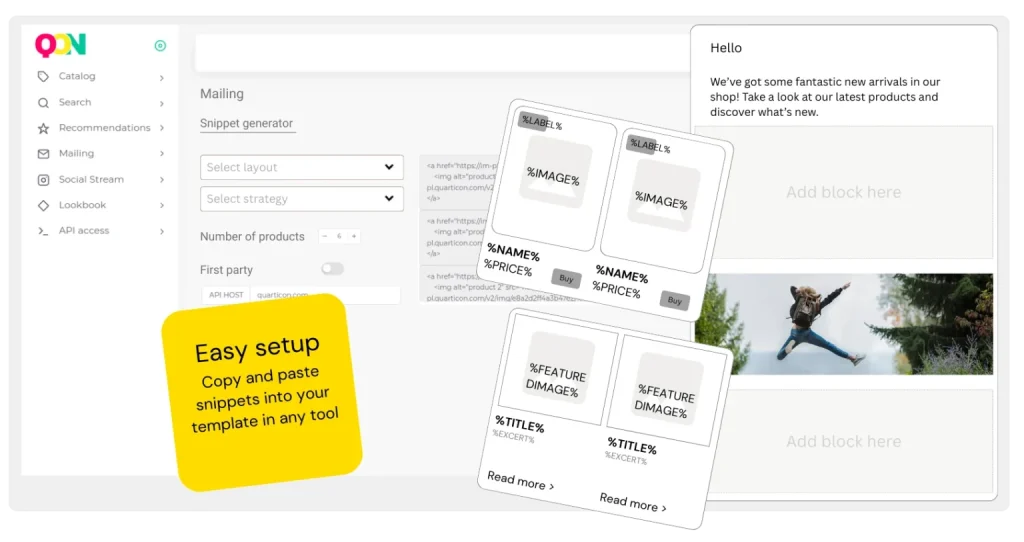
With AI-mails, e-commerce businesses can confidently offer autonomous product recommendations. Once a sale expires, the product block in emails is automatically updated to showcase current offerings. If discounted products are no longer available, the system effortlessly switches to a fallback strategy, displaying best-selling items. This real-time adjustment means that recipients always receive the most relevant and up-to-date offers, enhancing the likelihood of conversions.
Conclusion
As many e-commerce businesses raise concerns about efficiency of marketing automation in their industry, AI-mails seem to resolve all these concerns. AI-mails stand out for their ability to harmonize various channels and ensure that customers receive timely, personalized recommendations.
The tool is no longer optional; it is a necessity. By enabling autonomous product recommendations in emails, this tool enhances customer satisfaction, streamlines marketing efforts, and ultimately drives sales. For e-commerce businesses looking to remain at the forefront of innovation, investing in AI-mails in 2026 is a strategic move that promises to yield significant returns.
Web site: Quarticon’s AI-mails
AI-mails gained the Leader 2026 badge in March 2026.
You may read as well: Commerce Everywhere – the Main Shift in The Last Two Years